Robert Crawford’s commanding officer described marital strain tied to Air Force travel as the Brisbane murder trial heard evidence about messages and sprinkler tests.
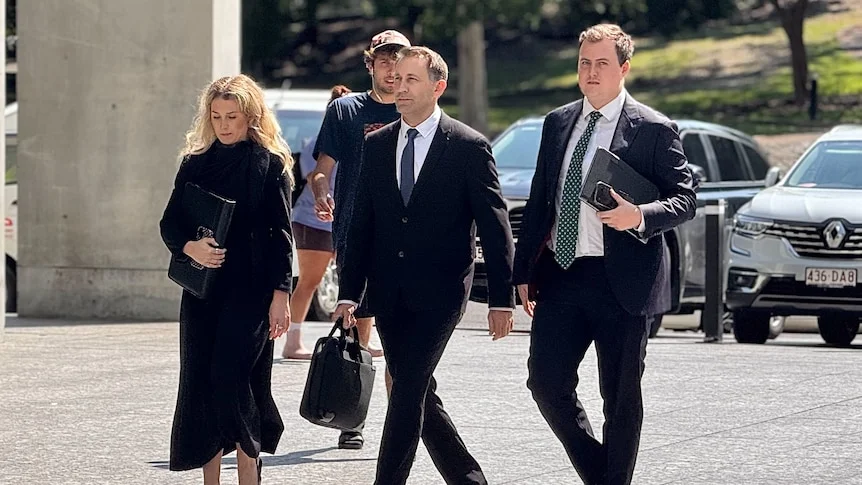
Evidence about Robert Crawford’s Air Force duties and marriage gave jurors a picture of tensions in the months before his wife Frances died. His commanding officer, Mark Seery, told the Brisbane Supreme Court that Crawford had said his wife no longer wanted him serving in the RAAF and that work travel was straining their relationship. The testimony also showed efforts to adjust his duties and repair the marriage, but those details don’t establish what happened at the couple’s property.
Crawford, a former RAAF pilot, has pleaded not guilty to murdering Frances Crawford, 49. Her body was found in July 2024 at the bottom of a retaining wall at the couple’s Upper Lockyer property, beside an overturned ride-on mower. Prosecutors allege he killed her and arranged the scene to appear accidental. That allegation remains to be tested against the evidence presented at trial, including testimony about the marriage and the physical circumstances surrounding her death.
Work travel and efforts to reconcile
Seery, Crawford’s squadron commanding officer, said the two men discussed marital difficulties during 2023 and 2024. Crawford was often upset, Seery recalled. He said Crawford had described problems between the couple and told him that Frances did not want him in the Air Force anymore. The account gives jurors a view of what Crawford told a colleague, rather than a complete picture of the couple’s private conversations or Frances’s perspective.
The jury had previously heard the couple separated after Frances discovered Crawford had been unfaithful. Seery said he didn’t know the details of their problems, but recalled Crawford saying medication Frances had started taking was “creating disruption between them”. That description is Crawford’s reported explanation, as recalled by Seery; the evidence described here doesn’t establish the medication’s effects or independently explain the couple’s conflict.
Messages from February 2024 showed Crawford telling Seery that a joint counselling session had gone better than expected. He planned to move back into the family home the next month, but added that there was “still a long road ahead”. The exchange suggests the reconciliation was underway but uncertain. A promising counselling session and a planned return home don’t, by themselves, show that the underlying problems had been resolved.
After the couple reconciled, Crawford continued to raise concerns about work travel, Seery said. Crawford told him Frances had objected to a trip to Townsville. Seery said they had discussed bringing Crawford back sooner, and that he later approved regular days off each week to ease pressure at home. The account connects workplace decisions to the strain Crawford described: travel could take him away from home, while changes to his schedule were intended to make the arrangement more manageable.
In messages shown to jurors, Seery thanked Crawford for taking a last-minute trip to Papua New Guinea in the weeks before Frances’s death. Seery wrote that he hoped it hadn’t stressed “the home front too much”. Crawford replied that Frances hadn’t been happy when he told her, but that getting away had been good for him. “I feel happy when I come to work,” he wrote. Seery said he understood Crawford was eager to get home. The messages capture competing pressures in a few lines: Crawford’s reported satisfaction at work, his wife’s objection to another trip, and his commanding officer’s awareness that the absence could add tension at home. (And this is the part most people overlook: the messages show what the men discussed, not what Frances thought beyond the reactions Crawford reported.)
Crawford later arranged to take “local flights only”, Seery told the jury, meaning he would not fly overnight. The evidence places his work arrangements alongside the prosecution’s account of a marriage under strain, though it does not resolve the central question of how Frances died. For jurors, the distinction matters. A troubled relationship may provide context for other evidence, but context alone can’t determine responsibility.
Sprinkler evidence under scrutiny
The trial has also examined Crawford’s account of the night Frances died. He told police he believed she was trying to move the mower because the sprinklers were due to start. That explanation links the mower’s position to a household task, making the sprinkler system’s timing and operation relevant to how jurors assess his account.
Detective Sergeant Troy Weston described tests he conducted on the sprinkler system. He found timers set for the afternoon and evening, but acknowledged that he hadn’t run the system with water to confirm it worked. He also said he hadn’t known Crawford had described a second system that could activate at random, and had not researched how the sprinklers operated. The limits are specific: the timers were inspected, while the system’s operation under the conditions described wasn’t verified through a water test.
“I didn’t read the instructions,” Weston told the jury.
That admission leaves a gap in the testing. In cases involving a household device, settings alone may not answer whether it operated as expected; jurors need to weigh what was checked against what remained untested. This is more significant than it looks because the sprinkler explanation depends in part on how the system could have behaved. The testimony described here doesn’t settle that question.
What the evidence can establish
The two strands of evidence serve different purposes. Seery’s account and the messages describe Crawford’s statements about work, travel and reconciliation; Weston’s evidence addresses how thoroughly the sprinkler explanation was examined. Neither strand, on its own, answers how Frances died. The jury must consider them alongside the rest of the evidence presented at trial.
If you’re following the case, the distinction between a witness’s recollection, a message shown in court and a test of physical equipment is worth keeping clear. Each can add context, but each has limits. The relationship testimony helps explain the pressures Crawford described, while the sprinkler testimony raises questions about how far investigators tested one part of his account.
The trial is continuing. Jurors will have to assess the evidence as a whole, including the prosecution’s allegation that Frances was killed and the scene made to look accidental. On the evidence described here, the marriage’s difficulties and the sprinkler system’s uncertain operation remain pieces of a larger case, not a verdict in themselves.
Discussion
Sign in to join the discussion.