Point Nemo, the world’s most remote oceanic spot, is not just isolated—it's a burial ground for space debris and home to deep-sea enigmas.
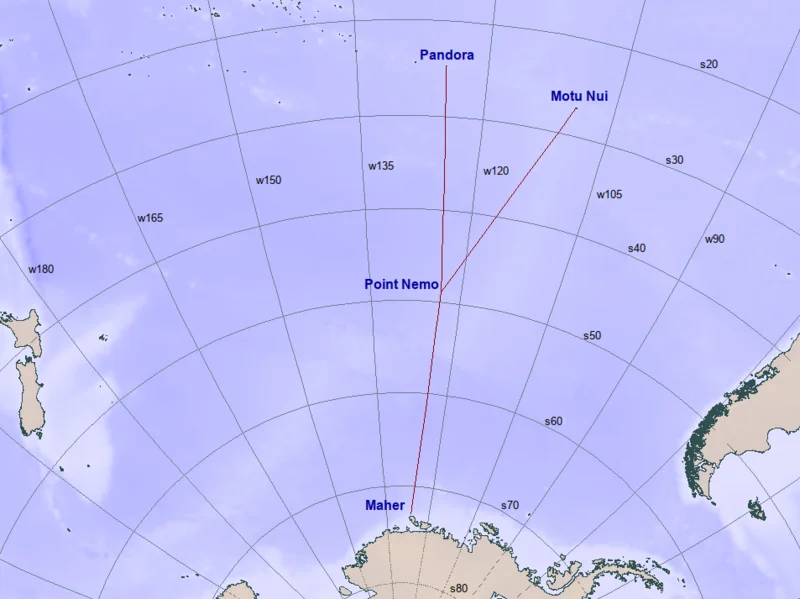
Point Nemo, often referred to as the most isolated location on Earth, draws attention from literature enthusiasts and space agencies alike. Situated at the coordinates 48°52.6’S 123°23.6’W, this remote area of the South Pacific Ocean stands as the farthest point from any land, with an intriguing history and a unique connection to both science fiction and space exploration.
Where Exactly is Point Nemo?
Finding the world's “middle of the ocean” was a challenge that required advances in technology. It was only in 1992 that Croatian-Canadian survey engineer Hrvoje Lukatela developed a program called Hipparchus that accurately pinpointed Point Nemo. Named after Captain Nemo from Jules Verne's classic novel Twenty Thousand Leagues Under the Sea, the designation predates the Pixar film Finding Nemo, which arrived over a decade later.
The Characteristics of Point Nemo
Point Nemo lies 1,670 miles (1,451 nautical miles or 2,688 kilometers) from three landmasses: Ducie Island to the north, a desolate atoll part of the Pitcairn Islands; Motu Nui, which is just south of Easter Island to the northeast; and snow-covered Maher Island in Antarctica to the south. This geography creates a defining area of ocean measuring approximately 8,650,778 square miles (22,405,411 square kilometers), larger than the former USSR.
Spacecraft Cemetery: A Grave for Debris
This location, also metaphorically called the Spacecraft Cemetery, has been the site of numerous controlled descents of decommissioned spacecraft. The Russian space program, among others, has frequently targeted Point Nemo for this purpose. Since 1971, nearly 300 spacecraft—including the famous Mir space station—have plunged into these waters. The decision to dispose of satellites and space vehicles at Point Nemo is deliberate, aimed at minimizing risks associated with falling debris.
When spacecraft re-enter the atmosphere, they can disintegrate and scatter dangerous debris over vast areas. Precautions are taken, ensuring that the relevant aviation and maritime authorities in neighboring Chile and New Zealand are notified prior to these descents, allowing for safe routing around the area.
The choice of Point Nemo reflects a blend of practicality and an eerie narrative. As we place these technological remnants into an inhospitable ocean, scientists can't help but draw parallels to fictitious underwater cities and mythic happenings.
The Lovecraft Connection
Before it became known as Point Nemo, H. P. Lovecraft utilized these desolate waters as the haunting backdrop for R’lyeh, the submerged city in his iconic work The Call of Cthulhu. The coordinates he provided are surprisingly close to Point Nemo, emphasizing the fascination with isolation and the unknown. Lovecraft depicted R’lyeh as a place steeped in danger and unnatural presence, an echo of ancient terrors lurking beneath the waves.
Interestingly, Lovecraft placed his fictive city at coordinates 47°9′S 126°43′W, a mere 205 miles (330 km) from Point Nemo, cementing the deep-seated connection between this remote location and the realms of horror fiction.
Unseen Terrors of the Deep
Point Nemo's enigmatic allure doesn’t end with its literary connections or its status as a resting place for spacecraft. In 1997, oceanographers detected an unusual, ultra-low frequency sound, dubbed “the Bloop,” emanating from the depths near Point Nemo. Initially too powerful to be attributed to known marine life, theories have proposed that the sound might originate from iceberg calving in Antarctica, yet the possibility of an undiscovered creature remains tantalizing.
There’s a macabre charm in the notion that such a remote spot might harbor mythical beasts like Cthulhu, who has found a home within the confines of Lovecraftian myth. With continuous space debris raining into these depths, one could fantasize whether the disturbance might awaken something slumbering in the silence of the ocean.
Point Nemo and Human Isolation
The remoteness of Point Nemo is so striking that when participants in the 2015 Volvo Ocean Race sailed near it, they were closer to the astronauts aboard the International Space Station than to anyone on land. Such realizations only heighten its intrigue, raising questions about human existence in conjunction with our planet’s vast and largely unexplored body of water.
As much as Point Nemo symbolizes solitude on Earth, it encapsulates a quieter, more profound narrative where science and mythology converge. It invites exploration—not just of its waters, but of our fears, our dreams, and our ongoing relationship with the mysterious unknown that constantly surrounds us.
Discussion
Sign in to join the discussion.