A falling tree killed a driver in Surrey as severe winds left more than 63,000 B.C. Hydro customers without power and prompted travel disruptions.
Storms leave a deadly mark
A second wave of powerful winds across British Columbia brought a fatal road incident in Surrey and widespread power outages over the weekend. The damage stretched across several regions, complicating the response: by Sunday morning, outages had fallen from a peak of about 135,000 customers to more than 63,000, while wind warnings remained in effect across parts of the South Coast and central Interior.
The falling outage count showed that restoration work was making progress, but tens of thousands of customers were still without electricity as another weather system approached. The combination of fallen trees, blocked roads and scattered outages also meant crews had to work across a large area while conditions remained unsettled.

Fatal crash and highway closure
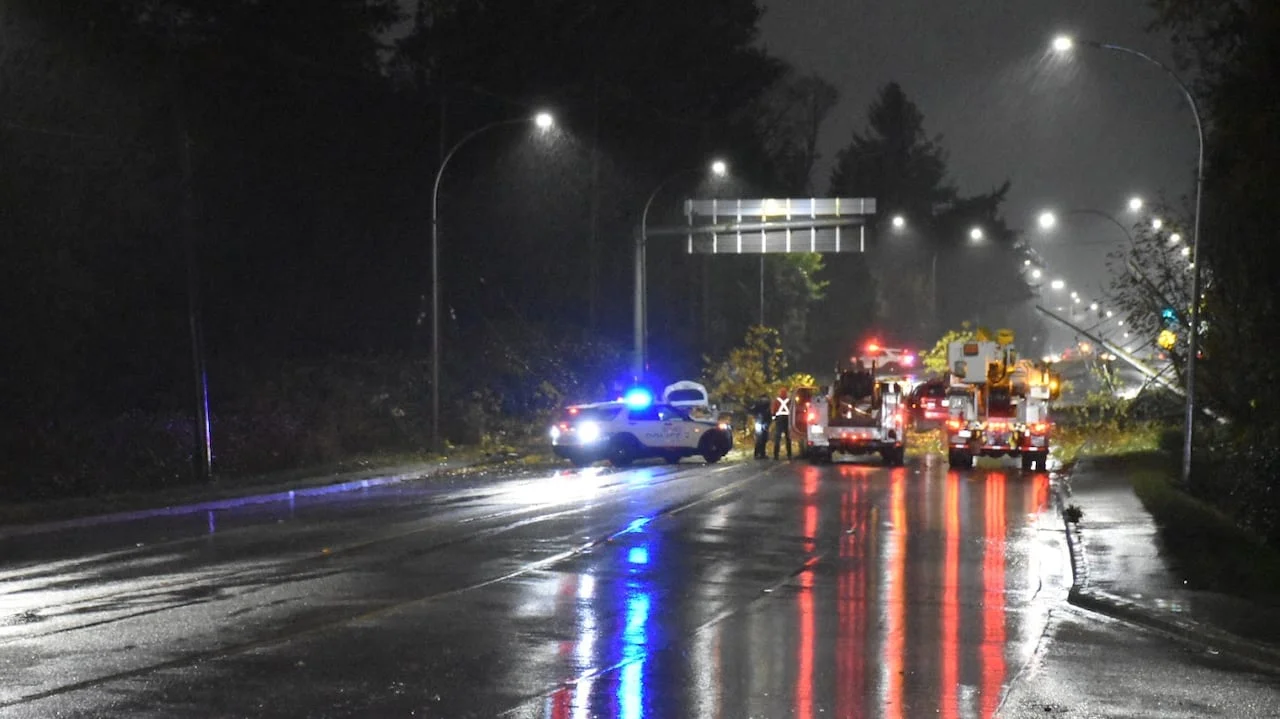
A tree fell across Highway 10 between 182 and 184 streets in Surrey at about 8 p.m. PT Saturday, trapping two vehicles, according to Surrey Police Service. One driver died at the scene; the other sustained minor injuries. The incident turned a stretch of highway into an emergency scene, with police and utility crews responding amid rain and strong winds.
The highway was closed overnight and later reopened with one lane operating in each direction. That limited reopening restored some movement through the area, though it did not immediately return traffic to normal. The incident unfolded as strong gusts swept the province, with Environment Canada recording winds of up to 90 km/h on Vancouver Island, 80 km/h in Prince George and 70 km/h in the Lower Mainland.
Those readings help explain why the effects were spread so widely: strong winds can bring down trees and damage power infrastructure in communities far apart. The Surrey fatality also put a human cost alongside the more visible tally of outages and transport disruption.
Outages ease as crews respond
More than half of the 63,000-plus B.C. Hydro customers without power at 7 a.m. Sunday were in the Lower Mainland and Sunshine Coast. Surrey, Duncan, Port Hardy and Prince George were among the hardest-hit communities. The remaining outages were distributed across a broad area, making the total count only part of the picture: restoration work also had to reach customers in separate locations.
B.C. Hydro spokesperson Whitney Deane said the scale and spread of the Friday and Saturday storms required crews to remain in their own regions, with contractors brought in to help. “All hands are on deck, but we're responding in all regions of the province,” Deane said. The need to keep crews close to where they were already working reflects a basic challenge in widespread outages: moving resources between regions can be difficult when several areas need attention at once.
The utility aimed to restore power to most customers in the Lower Mainland Sunday morning and to everyone else by the end of the day. That was a target, rather than confirmation that every repair would be completed on schedule; weather, access and the location of damage can all affect restoration work. After multiple cancellations Saturday, B.C. Ferries said conditions had improved and it was resuming scheduled service on Sunday.
For residents, power restoration and transport service were immediate measures of whether conditions were improving. But a lower outage count didn’t mean the storm’s effects had ended for everyone. Some customers still faced uncertainty while crews worked through repairs.
Warnings continue, with another system ahead
Wind warnings covered Metro Vancouver, the Fraser Valley, the Sunshine Coast and Vancouver Island south of Sayward, as well as central Interior areas including Prince George, Stuart-Nechako and the Lakes district. Environment and Climate Change Canada said gusts could reach 90 km/h before easing around midday. That broad warning area meant people in both coastal and Interior communities were being asked to account for further strong winds.
“We have seen the worst,” said ECCC meteorologist Catherine Aubrey. Monday was expected to bring a brief respite, with showers forecast. A new system was then expected Tuesday, bringing more wind and as much as 50 millimetres of rain to parts of the South Coast, including Vancouver Island, Howe Sound and the North Shore.
The pause on Monday offered a window for repairs, but it was short. And this is the part most people overlook: when another system follows quickly, crews may have little time to finish restoration and prepare for fresh damage before conditions change again.
What the forecast means for the response
The sequence of storms puts pressure on both utility crews and residents. Repairs need access to damaged equipment and fallen trees, while renewed wind and rain can make that work harder or create new problems. The stated restoration targets give customers a useful expectation, but the incoming system makes the timing difficult to treat as settled.
If you're in an affected community, the practical signal to watch is the local warning and outage information, alongside updates to road and ferry service. This is more significant than it looks: a storm’s impact isn’t measured only by its strongest gust, but by how long disruptions persist and how much recovery can be completed before the next round of weather arrives.
For now, the province is dealing with two tasks at once: restoring service after the weekend’s damage and preparing for another system. A brief break. The success of the response will depend on what crews can complete during that interval and how conditions develop when the next system reaches the South Coast.
Discussion
Sign in to join the discussion.