A third wave of bomb threats affected at least 27 European flights, prompting searches, diversions and fighter jet escorts; no explosives were found.
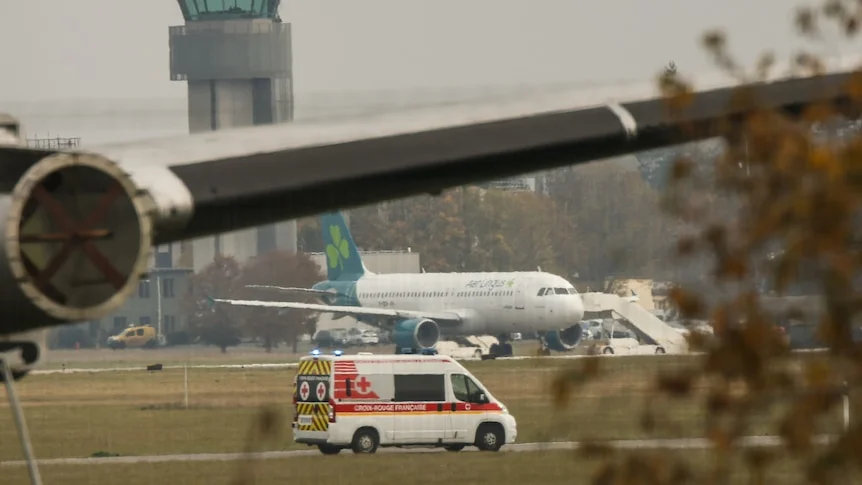
At least 27 flights across Europe received bomb threats on Thursday, creating the week’s largest wave of aviation disruption. No explosives have been found, and authorities have yet to identify the source. Similar threats affected a smaller number of flights on Monday and Tuesday.
The incidents put airlines and airport authorities under pressure to assess threats while keeping schedules moving. Joji Waites, director of flight safety at the British Airline Pilots’ Association, said airlines generally act on threats after assessors determine they are credible. Aviation cybersecurity executive Eliran Almog said false alarms can also reveal how airlines, airports and authorities respond.
Threats trigger searches and diversions
The disruptions stretched from Scandinavia to the Mediterranean. In France, Prime Minister Sébastien Lecornu’s office said fighter jets intercepted an Aer Lingus flight from Dublin to Rome and escorted it to the military air base at Évreux. The pilot had not followed instructions as expected; officials gave no further explanation.
Bulgaria’s air force said its jets escorted three passenger aircraft to the ground. Two Ryanair flights bound for Sofia, from Copenhagen and Madrid, landed as scheduled. A third, from London, diverted to Plovdiv.
Spanish authorities received three emailed threats in less than 20 minutes. They referred to two Air Europa flights due to leave Madrid for Paris and four Iberia flights arriving from Rome and Milan. Several aircraft at Madrid airport were held or returned to their stands, and passengers left the planes while they were searched.
In Warsaw, a LOT flight to Paris stopped during taxiing and passengers moved to another aircraft. A flight from Cork was delayed by 90 minutes after a threat was reported to the airport operator. Copenhagen police said two aircraft were searched.
Other flights continued to their destinations after receiving threats. These included two EasyJet flights from Britain, one flight each from Ireland and Greece, and a Finnair service from Helsinki to Vienna. LOT’s Warsaw-to-Brussels flight, a Wizz Air flight from Milan to Bucharest and an Air Serbia flight from Belgrade to Bucharest also landed as planned.
Italian media reported that a Wizz Air flight from Milan to Warsaw diverted to Vienna. The news agency ANSA said two aircraft landed as scheduled in Milan. A person familiar with the matter said Italy’s air force escorted a Finnair flight from Helsinki to its planned arrival in Rome. Fiumicino Airport said services had not been disrupted.
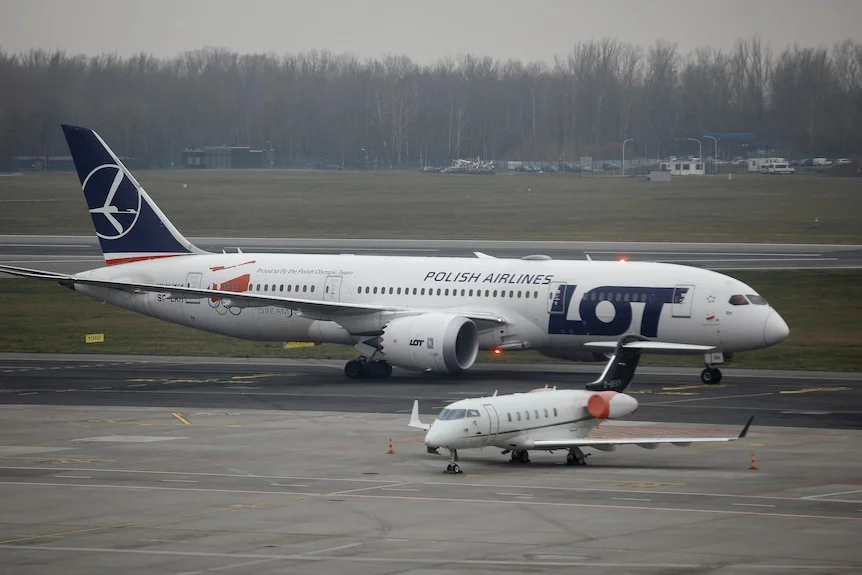
Poland's LOT airline said its flight from Warsaw to Brussels landed safely in Brussels after a security warning. (Reuters: Kacper Pempel)
Two Finnair flights from Helsinki were among those affected, one bound for Rome and the other for Vienna. Passengers at Fiumicino described taking the disruption in stride. “We still have to get around,” Spanish traveller Lucia Parga said. “We just have to deal with it as best we can.”
Threats arrive amid wider service disruptions
The aviation incidents have drawn attention because several European countries have recently reported suspected sabotage and other hostile activity against essential services. Denmark, Poland and Romania have previously accused Moscow of involvement in such activity; Germany blamed Russia for an attack on Leipzig airport in August. The UK has previously blamed Russia in other cases and linked Iran to a suspected plot against a US air base. Russia and Iran deny involvement.
Eric Schouten, head of aviation security group Dyami, said many countries affected by the threats support Ukraine. He described aviation as one of several sectors potentially exposed to what he called “hybrid warfare,” alongside railways, supermarkets, blood banks, energy and internet services.
Almog also pointed to cyberattacks on supermarket refrigeration systems across Europe during the same period. Unidentified hackers had disrupted supermarket fridges in several countries for a second time that week, while French blood banks were also affected. “Different essential services are experiencing disruption that carries economic costs and can undermine public confidence,” he said.
At least seven flights and a cruise ship had received hoax threats on Tuesday. With Thursday’s incidents expanding the number of affected flights, the immediate challenge for aviation operators is to distinguish credible warnings from false alarms while limiting disruption to passengers and schedules.
Discussion
Sign in to join the discussion.