Heavy rain and poor visibility cancelled Phillip Island’s final MotoGP race, ending the circuit’s run before the event moves to Adelaide in 2027.
Phillip Island’s MotoGP farewell ended without a race. Heavy rain and poor visibility forced organisers to cancel Sunday’s event, which had been due to become the final MotoGP round at the Bass Coast circuit after three decades. The ending was abrupt in the practical sense: the schedule was pushed back, then abandoned, leaving riders and fans with a send-off that couldn’t include the race itself.
A long delay, then cancellation
The race was scheduled to start at 2pm, but organisers delayed it while they waited to see whether conditions might improve. A 4:30pm start became the hoped-for alternative. At 3:30pm, they called the race off, after fans had spent hours in wet conditions. Riders held a farewell lap at 3:45pm.
That sequence captures the difficult balance behind a weather delay. Organisers need to judge whether a temporary hold could allow an event to proceed, while also accounting for how conditions affect visibility, track use and the support systems around a race. In this case, the wait didn’t produce a safe window. The cancellation came before the later proposed start time, and the farewell lap offered a brief moment on track after the race had been ruled out.
The Australian Grand Prix Corporation said poor visibility meant the medical helicopter could not fly. “Safety must always come first, and racing cannot take place without the medical helicopter able to operate,” it said, acknowledging the decision would disappoint fans, teams and event staff.
The helicopter requirement is a reminder that a race depends on more than whether riders can physically take to the circuit. Motorsport events rely on emergency arrangements being available if something goes wrong, and organisers have to consider those arrangements alongside the weather and track conditions. Here, the corporation identified the helicopter’s inability to operate as the reason racing couldn’t continue. That’s a clear operational limit, even if it offered little comfort to people who had waited through the delay.
Racing and celebrations washed out
The Moto3 and Moto2 races and the third Australian Superbikes race had already been cancelled earlier in the day. Organisers also called off the official warm-up, trackside entertainment including monster trucks, and a legends lap featuring world champions Mick Doohan, Casey Stoner and Wayne Gardner.
The cancellations affected more than the headline MotoGP event. A race weekend is built around a programme of sessions and activities, and when weather disrupts that schedule, each decision can narrow what remains possible for spectators. The earlier losses meant the day was already reduced before the main race was cancelled. Then the warm-up, entertainment and legends lap also fell away, stripping out both competition and the celebratory parts of the farewell.
(And this is the part most people overlook.) The legends lap was meant to connect the event’s past with its final MotoGP appearance at Phillip Island, while the races would have provided the sporting conclusion. With both cancelled, the riders’ farewell lap became the available on-track gesture. A gesture, but not the ending the occasion had been built around.
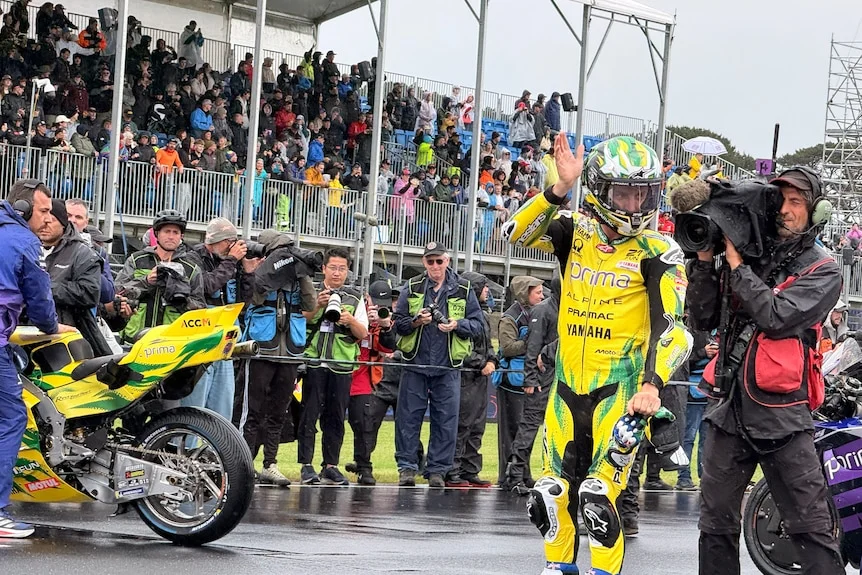
Jack Miller farewells fans after the race was cancelled. (ABC News: Madeleine Stuchbery)
The corporation said Sunday ticketholders would receive full refunds, with partial refunds for people holding multi-day tickets. That addresses the ticket cost, but it can’t restore the day fans expected: the racing, the planned entertainment and the chance to see the circuit’s MotoGP story end with a final event. For teams and event staff, too, the cancellation meant a long day of weather decisions and a programme that couldn’t be completed.
Phillip Island’s final MotoGP round
The cancellation closed the circuit’s MotoGP chapter before the event moves to a street circuit in Adelaide in 2027, following three decades at Phillip Island. The planned last race instead became a rain-soaked send-off, with riders and spectators unable to complete the farewell on track.
That change of venue gives Sunday’s cancellation extra weight. Phillip Island wasn’t simply hosting another round that happened to be disrupted; it was due to host the final MotoGP round there after a long run. The source of the disappointment is therefore twofold: the race itself was lost, and the scheduled sporting conclusion at this circuit won’t be repeated as part of the move to Adelaide. This is more significant than it looks. A final event gives a long-running venue a chance to mark its place in the sport, and weather removed much of that opportunity.
There’s a limit to what can be inferred from one cancelled Sunday. The move to a street circuit in Adelaide is stated for 2027, but the details of how that event will compare aren’t established here. What is clear is the contrast in setting: Phillip Island’s MotoGP run ends at the Bass Coast circuit, while the next chapter is planned for Adelaide. If you’re a fan who came for the farewell, the intended transition now sits alongside an unfinished last day.
What the cancelled farewell leaves behind
For organisers, the immediate priority was a decision they said depended on the medical helicopter being able to fly. For fans, the outcome was a day of delays, cancellations and a short farewell lap instead of the final race they’d come to see. Both facts can be true at once: the safety condition was decisive, and the disappointment was substantial.
The episode also shows why a scheduled finale can’t guarantee a satisfying ending. Weather can reshape a race programme, and the more an occasion depends on one final sporting moment, the more visible that disruption becomes. Phillip Island’s MotoGP history has run for three decades, but the last round there will be remembered, at least in part, for the race that never started. That’s an unsatisfying ending. It’s also the one the conditions left organisers able to deliver.
Discussion
Sign in to join the discussion.