Domain reports a 4.7% quarterly fall in capital city house prices, as higher borrowing costs and weaker buyer confidence weigh on demand.
A national housing downturn takes hold
Australia’s housing downturn has spread across every capital city, with house prices falling 4.7 per cent in the September quarter—the steepest quarterly decline in Domain’s records. That breadth matters: conditions that once varied sharply between cities are now moving in the same direction. A fall across all capitals suggests the pressure has reached beyond individual local markets and become a broader shift in buyer demand.
Domain puts the combined capital city median house price at $1,226,566. Perth recorded the largest quarterly fall, down 7.4 per cent. Sydney prices fell 4.7 per cent and Melbourne’s dropped 3.3 per cent, the biggest quarterly declines in those cities in four years. The figures show the downturn has different depths, but no capital city escaped it.
Unit prices also fell 3.5 per cent, marking a second consecutive quarter of declines for both houses and units. That shared direction gives the figures more weight than a single weak quarter in one part of the market. Still, a citywide median can hide substantial variation between suburbs, property types and price brackets.
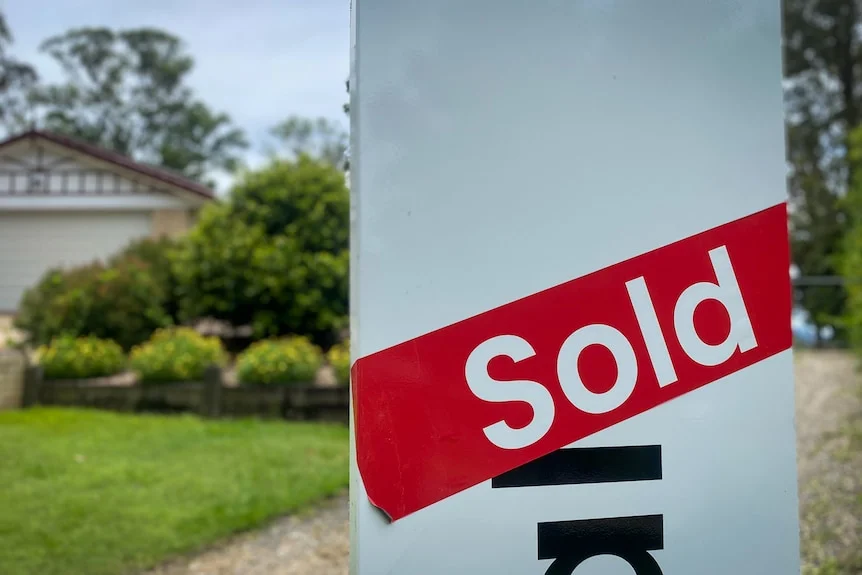
Houses and units dropped in price for a second consecutive month. (ABC News: Steve Keen)
Buyers gain room to negotiate
“What began as weakness concentrated in some cities has broadened considerably,” said Nicola Powell, Domain’s chief residential economist. She described the shift as a change in the housing cycle, with sellers facing longer sales times and buyers gaining more scope to negotiate. That change is practical as well as statistical: a seller who waits longer for an offer may have less room to hold firm on price.
Here's the thing: more negotiating power doesn’t automatically make housing affordable. It can give buyers greater choice or time to assess a purchase, but the size of a price decline has to be considered alongside borrowing costs and household budgets. The numbers here are underwhelming for buyers hoping that a market correction will quickly close the affordability gap.
That shift reflects pressure on demand. Gerard Burg of property data firm Cotality called the decline “a demand-led downturn,” citing the combined effects of interest rate rises, reduced affordability and cost of living pressures. Three consecutive rate increases have also weakened market confidence, he said. When buyers face a higher cost of borrowing and uncertainty about prices, some may delay a decision, reducing competition for homes.

Nicola Powell says conditions have shifted to be more favourable for buyers. (Supplied)
Auction activity offers another measure of the pullback. Cotality counted 1,423 auctions across the capitals last week, roughly half the number recorded at the same point last year. Lower auction volumes can make it harder to read demand from sales alone: fewer homes are being brought to market, so the available evidence reflects both buyer caution and seller choices.
Cameron Kusher, a property economist, said borrowing capacity had fallen sharply and buyers were questioning whether to act while prices and confidence are still under pressure. If you're working in this space, that hesitation matters because it can reinforce the slowdown: fewer willing buyers may leave sellers waiting, while prospective buyers watch for further falls.
Higher-priced homes feel the pressure first
The downturn is uneven within cities. Cotality data shows Australia’s most expensive homes have generally lost more value than lower-priced properties. In Sydney, the top quartile fell by more than twice as much as the lowest quartile during the September quarter. Lower-priced homes were comparatively steady nationwide, and prices in Darwin’s lowest-value quartile rose.
The split points to a market where the capacity to borrow and the size of the buyer pool differ by price range. Kusher attributes the divide to a smaller pool of buyers at the top end, alongside higher borrowing costs. Those properties had also recorded larger value gains in recent years, he said, leaving more scope for a correction after stronger growth.
The ultra-expensive segment has remained largely stable, while more affordable homes still draw from a wider group of potential buyers. That distinction complicates any simple account of a national slump: the steepest declines are not necessarily concentrated at the very top, and lower-priced homes aren’t uniformly falling. The shape of the downturn depends on which part of the market is being measured.

Cameron Kusher says fewer buyers and higher interest rates are pushing down the prices of more expensive properties. (ABC News: Lucas Hill)
“The median house really appears kind of out of reach of the median income household across much of the country,” Burg said. That affordability gap helps explain why lower-priced homes have held up better even as the wider market contracts. A comparatively resilient segment can still be inaccessible to many households; relative stability isn’t the same as affordability.
A downturn that began before the budget
The May federal budget’s changes to investment taxes may have added to uncertainty, but they came after prices had already peaked and begun to fall, Kusher and Burg said. Burg pointed to higher interest rates as an earlier factor behind weaker confidence. The timing matters when weighing causes: the budget changes may have affected sentiment, but the downturn was already under way.

While the changes to the budget have been a factor, house prices were decreasing before the budget. (ABC News: Matt Roberts)
The slowdown is changing buyer behaviour, particularly among first-home buyers. Kusher said stretched affordability and falling confidence had left many weighing whether to wait while more properties come to market. Waiting may offer more choice if listings grow, but it also leaves buyers trying to judge whether prices have further to fall.
What the slowdown means for the next phase
Kusher expects the downturn to continue until interest rate cuts appear likely, with a near-term return to previous price highs unlikely. That outlook is conditional: it links the market’s direction to expectations about borrowing costs and confidence, both of which shape how many buyers can and will act. The available figures show a clear weakening, but they don’t establish how long it will last.
This is more significant than it looks because the downturn combines falling prices with fewer auctions, weaker confidence and uneven pressure across price brackets. And yet, lower prices alone won’t resolve the underlying affordability problem Burg described. For buyers, the immediate change is greater room to negotiate in some parts of the market; for sellers, it’s a reminder that recent gains don’t guarantee a quick sale. A reset, with no simple end point.
Discussion
Sign in to join the discussion.