Paleontologists uncovered a remarkable feather preserved in ancient dinosaur dung, revealing insights into avian evolution and survival during extinction events.
In a surprising find, researchers have discovered a well-preserved feather situated within fossilized dinosaur coprolite, which may shed light on the evolutionary journey of birds. This remarkable discovery highlights the coprolite's potential as a new source of information regarding soft tissue preservation from the dinosaur age.
Published in Current Biology, the study's lead author Jingmai O'Connor, who serves as an associate curator of fossil reptiles at the Field Museum in Chicago, emphasized the fortuitous nature of the find. "This is the first-ever feather found in a coprolite, and it likely wouldn't have been discovered without a lucky break," O'Connor remarked.
A Noteworthy Find
While searching through fossilized remains at the Hell Creek Formation in Montana, paleontologist David DeMar stumbled upon a nodule about the size of a golf ball. Initially focused on uncovering fish fossils, DeMar was astonished to discover a distinctive dark reddish-brown stone encasing the feather. "When I examined it through my hand lens, I couldn't believe I was seeing a tiny fossil feather," he recounted excitedly. It’s one of those moments in paleontology that can change the narrative of evolutionary history. The serendipity of such discoveries often reminds us how much remains hidden beneath layers of rock and time.
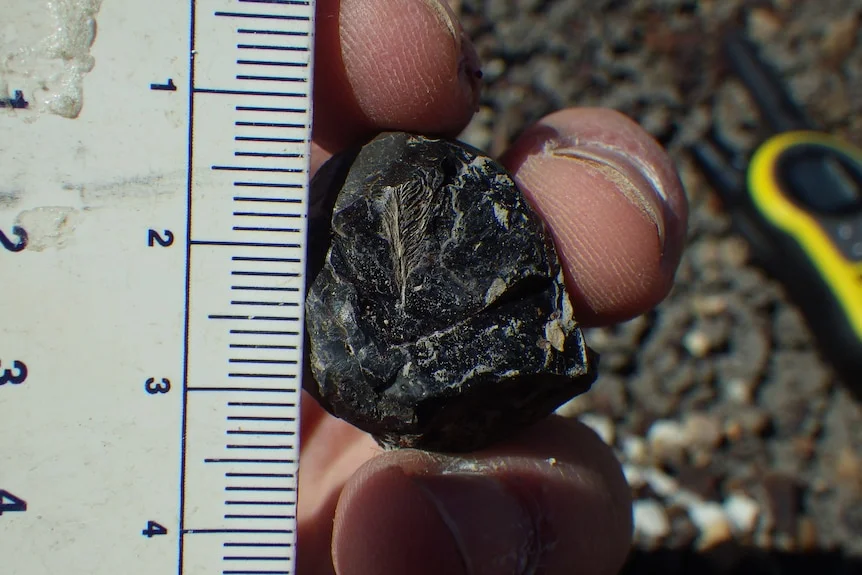
David DeMar photographed the exposed feather upon its discovery in 2016. (Supplied: David DeMar Jr.)
The Significance of Coprolites
Coprolites, the scientific term for fossilized excrement, offer a rare glimpse into dietary habits and ecological interactions of prehistoric life. Their preservation is uncommon since organic materials typically decay over time. This discovery not only confirms the feather's existence but also opens up possibilities that there may be more undiscovered specimens contained within other coprolites, waiting for researchers to unearth them.
Using micro-CT scanning techniques, researchers found that this particular coprolite contained various minute fish scales and the leg bones of small birds, revealing intriguing details about the creature's diet. O'Connor noted, "The presence of fish scales indicates a complex web of interactions in ancient food chains." These findings illustrate how interconnected different species were, pointing to a rich network of predator-prey dynamics in ancient ecosystems—a stark reminder of how these relationships shaped evolutionary paths.
Not Just Another Feather
The feather itself is thought to belong to a now-extinct group of aquatic, flightless birds known as hesperornithiformes, which perished during the mass extinction event 66 million years ago. While many bird groups faced extermination, the lineage leading to modern birds managed to survive, adapting in ways that are still not fully understood. What made these ancestors resilient? This finding could provide crucial insights into the evolutionary pressures that enabled survival amidst widespread extinction.
As vertebrate paleontologist Steven Salisbury from the University of Queensland pointed out, this feather is exceptional because it represents actual preserved soft tissue in three dimensions, an ongoing rarity in paleontology. He noted the formidable fossil record of Hell Creek, which has been extensively studied yet continues to yield unique discoveries. Clearly, the more we explore, the more we realize how many questions still remain unanswered. (And this is the part most people overlook: exploration often leads to more mysteries rather than conclusions.)
A Call to Action
Dr. O'Connor's team regards this finding as a pivotal moment for enhancing future research. She expressed hopes that their discovery will stimulate a broader search for feathers in other collections of fossilized feces, stating, "It's a call to action for scientists to look into other coprolites across the globe. Who knows what else might be hidden inside?" The challenge now is to spark curiosity within the scientific community. If you're working in this space, consider what you might find by revisiting old collections or sampling new sites.
As researchers delve into the potential within these organic remnants, our understanding of avian evolution, survival strategies during adverse conditions, and the dynamics of ancient ecosystems could be significantly enriched. Every feather or scale found in fossilized remains has the potential to shift the focus of evolutionary biology.
Implications for Evolutionary Research
The discovery of this feather underscores the intricate links between ecology, evolution, and extinction, illustrating that even in decay, history may reveal itself in the most unexpected forms. The implications of this research extend beyond mere fascination; it invites reconsideration of how paleontologists approach fossil records. The revelations about ecological interactions could lead to a deeper understanding of how modern ecosystems function and the resilient characteristics found in today's avian species.
This find fits into a broader framework of research where multidisciplinary approaches—combining biology, paleontology, and even technology—are helping to unearth deeper truths about our planet's history. Up ahead, we may see shifts in how we study both current and prehistoric species, potentially changing our interpretations of their evolutionary significance.
Discussion
Sign in to join the discussion.