Solar storms pose a significant risk to our power systems, with potential damage in the trillions if a major event were to strike Earth today.

The Unseen Threat: Solar Storms and Their Potential Impact
Earth faces a myriad of pressing challenges: ongoing wars, political unrest, and health crises, all set against the backdrop of deepening energy, climate, and water issues. Yet amid these terrestrial concerns, we must also consider a looming danger from above: solar storms. Unlike our familiar natural disasters—earthquakes and hurricanes—that can and do wreak havoc on our daily lives, the consequences of solar activity are less immediate but potentially far more catastrophic. A significant solar storm, if it were to hit Earth without any protective measures in place, could ignite electrical fires and cripple power stations, resulting in damage that runs into the trillions and affects billions.Historical Context: Lessons from the Past
The most notorious solar event in recorded history occurred in 1859, known as the Carrington Event. But evidence suggests that an even mightier solar storm took place over a millennium earlier. Between 774 and 775, researchers detected a remarkable surge in carbon-14 in tree rings, indicating a cosmic occurrence far beyond anything we can fully anticipate. This spike was attributed to a solar storm, lending credence to the worry that our planet could be more vulnerable to such events than we ever imagined. If a similar storm were to occur today, the outcome could be unprecedented and devastating.Sun-Spotting: The Science of Solar Disasters
The field of solar astronomy is relatively new, having gained traction only after Galileo’s early 17th-century observations of sunspots. These blemishes on our star were initially dismissed as imperfections, but we’ve since learned they are intrinsically linked to solar flares—a connection cemented in 1859 when astronomer Richard Carrington observed a solar flare that precipitated the most intense geomagnetic storm of the 19th century. That storm created stunning auroras at low latitudes and even caused telegraph systems to spark, sometimes igniting fires despite being disconnected from power sources. Fast forward to today, with our highly developed electrical infrastructure, a similar solar event could spell disaster on a monumental scale.More to the Story: Additional Solar Storms in Modern Times
Since Carrington's time, various solar storms have troubled Earth, leading to incidents like the 1921 geomagnetic storm, which ignited fires near Grand Central Terminal in New York, and the 1989 event that resulted in extensive power outages in Quebec. Perhaps the most poignant near-miss occurred in 2012, when the Sun unleashed a ferocious eruption comparable to the Carrington event. Luckily, it missed Earth, but if it hadn’t, the financial and human toll could have been catastrophic.Tree Rings and Cosmic Clues
The scientific community has made significant strides in reconstructing solar events from over a millennium ago, primarily using tree rings. Each year, trees form a new ring, enabling scientists to track atmospheric carbon-14 levels over time. A startling increase of 12% in carbon-14 around 774-775 was documented, marking the most substantial spike observed in history. This was not merely a localized phenomenon; tree-ring data confirm it was a simultaneous global event. While such carbon-14 increases could theoretically result from other cosmic phenomena—like gamma-ray bursts or supernovae—the available evidence, including ancient records and isotopic data from ice cores, supports the conclusion that a solar storm is the most plausible explanation for this atmospheric anomaly. This intersection of ancient history and modern science highlights not just our vulnerability but the urgency of preparing for potential solar threats. By understanding these cosmic risks, we can begin to strategize on mitigating their effects. If you're operating in sectors sensitive to solar weather, the implications of this research are profound. You won’t find immediate solutions in the data, but recognizing the risk is the first step. We need to be better prepared before the next solar storm forces our hand.The Staggering Risks of Solar Storms
Those studying solar activity with a keen eye should take a hard look at the implications of our Sun's unpredictable behavior. Historical data reveals that past solar events, particularly the one from 774 to 775 AD, were not just natural phenomena; they were signals of potential catastrophe. This spike in carbon-14 aligns with ice core records, suggesting a significant solar flare that might have been far more powerful than any contemporary event, including the notorious Carrington event of 1859. If recent analyses are correct, we’re not merely facing a possibility of another Carrington-like event; we're confronted with the distinct likelihood of something far worse. It's unsettling to think that these colossal solar disturbances can escape our attention until they happen. While infrastructure upgrades are no small feat, the threat of a solar storm is real and immediate. Imagine millions left without power, a scenario that played out in Texas during a winter storm—though on a much grander scale. We're talking about a singular event that could plunge billions into darkness and chaos, sparking uncontrolled satellite collisions and widespread electrical failures. The data supports it; events from the past confirm that when the Sun unleashes its fury, the consequences can be catastrophic. Yet, here's the kicker: We’ve been a bit complacent in our understanding of solar threats, often underestimating their potential for devastation. The landscape has shifted with new research indicating solar storms can reach ten times the intensity of those we’ve recorded in recent history. This isn't just theoretical. It hints at a catastrophic cascade affecting everything from satellite operations to terrestrial electrical grids. Are we ready for that kind of impact? The uncomfortable truth is that we must be, and quickly. One thing is clear: our current systems are ill-prepared for such an eventuality. If we're to avert an unprecedented disaster, it's imperative that we take proactive steps. Upgrading the power grid, reinforcing energy infrastructures, and preparing not only technology but also communities for possible outages aren’t just good ideas—they're essential. Ignoring the Sun’s power and our infrastructural vulnerabilities could lead to a reality where we’re scrambling to recover instead of effectively managing a crisis. Stepping back, if you work in energy, technology, or disaster preparedness, these findings shift the narrative from speculation to urgent action. We stand on the cusp of either fortifying our civilization against these formidable natural forces or facing the dire consequences of inaction. The time for preparation is not tomorrow or next year; it’s right now.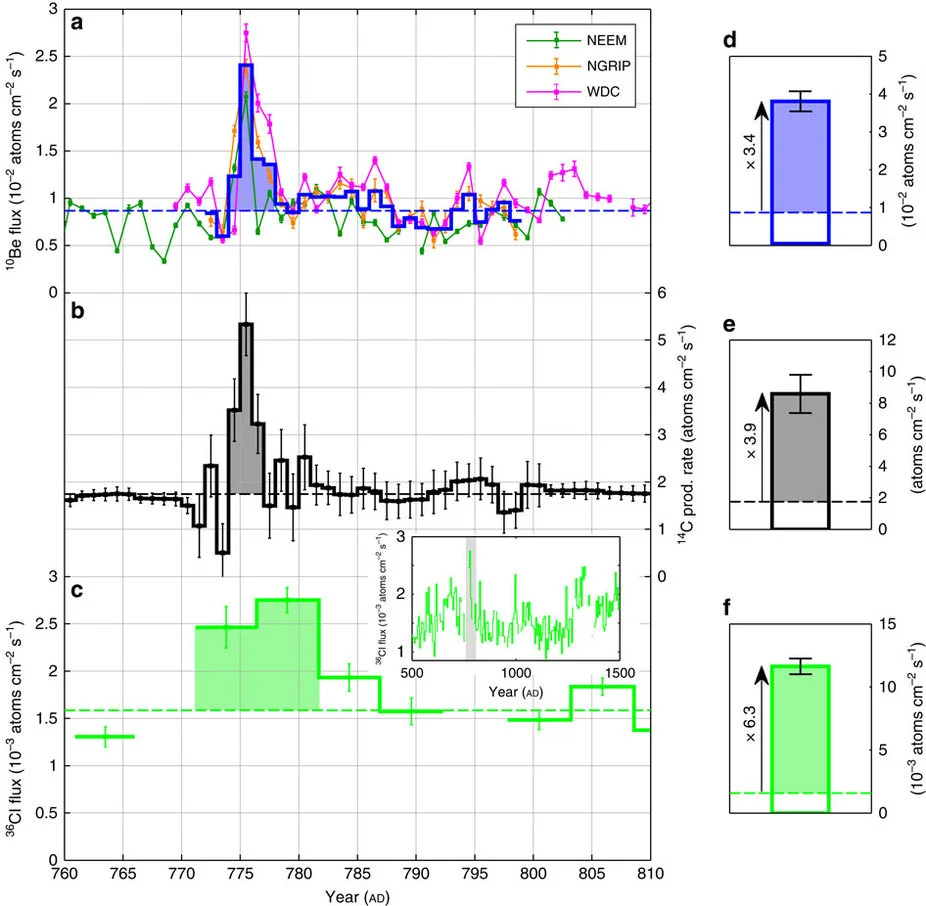
The carbon-14 data (center) along with the associated spikes in the ice core data of beryllium-10 (top) and chlorine-36 (bottom) are all consistent with a proton-rich solar flare event for the origin of the excess signal seen from 774 to 775.
In February of 2021, an estimated 4.4 million Texans lost power due to a winter storm. In the event of a grid-overloading space weather event, there could be over a billion people across the world left without power, a global series of fires, and a chain reaction of uncontrolled satellite collisions. All of that adds up to a natural disaster without precedent in the history of the world.
Discussion
Sign in to join the discussion.