Hundreds rallied at SA Parliament against Quantum DC's proposed 1,200-megawatt Tungkillo data centre, rejecting a pause and demanding the project be stopped.

Hundreds of people gathered on the steps of South Australia's parliament on Sunday to tell Quantum DC that its proposed 1,200-megawatt AI data centre isn't welcome in the Adelaide Hills. The company had paused the project only days earlier, and the crowd made clear that a pause doesn't settle anything for them.
A pause, not a stop
Quantum DC announced earlier this week that it would hold off on its Tungkillo development after months of frustration, anger and protests from nearby residents. For the community, that was a partial win at best. At least 250 people turned out on Sunday, and campaign organiser Magdalene Lippett said she believed the fight was close to being won, though not finished.
"There has been a pause, but a pause isn't a stop. We want this thing stopped,"she said.
What stood out was the cross-party support. The SA Liberals, the Greens and One Nation all backed the protest group, and independent federal MP Rebekha Sharkie joined them. A grassroots campaign drawing that range of political backing is harder to dismiss as a fringe complaint, and it puts pressure on the company to answer for more than a single development application.
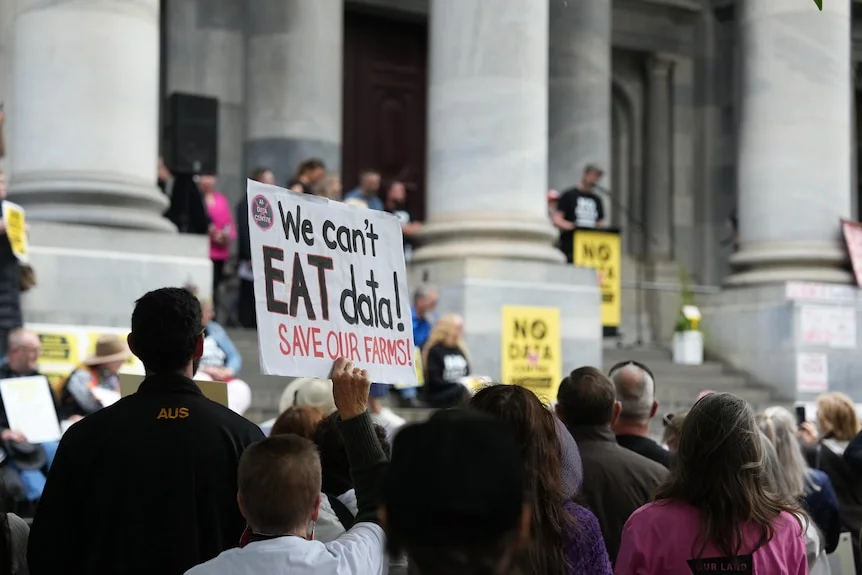
An estimated 250 people attended the rally. (ABC News: Trent Murphy)
Farmland and fire risk
The farming argument carried much of the afternoon. Local farmer Kym Gladigau said the proposed site is prime land for food production, and that the Adelaide Hills was zoned for that purpose from the start.
"The Adelaide Hills is a food production area, that's what it's all about," Mr Gladigau said.
He pointed to recent losses closer to Adelaide. "We're losing farmland at Mt Barker, we've lost it at Virginia," he said. "The risk with this data centre, is that we lose that."
Gladigau also raised fire risk, a concern that carries weight in a region with a long memory of bushfires. "If this thing goes wrong … we cannot afford another big bushfire in the Adelaide Hills, and who is going to tackle it?" he asked.
Liberal leader Ashton Hurn agreed the land should stay in agricultural use. Her point was about scarcity more than sentiment.
"We've got a very finite amount of prime agricultural land in South Australia … we have to fight as best we can to protect our farmers and our agricultural land,"Ms Hurn said.
Ms Hurn didn't reject data centres outright. "We keep hearing that data centres are a part of our future, there are of course economic opportunities, but we also need to make sure the community is brought along for the ride as well," she said.
Politics and the grid
Greens leader Robert Simms went further. He said his party is moving a motion calling on the government to reject the Tungkillo proposal, and he wants a statewide moratorium on data centres while the questions are answered.
"We don't want to see South Australia become the test dummy for the nation," Mr Simms said.
Energy Minister Tom Koutsantonis took a different line, though he was no more supportive of the developer. He said he was "very disappointed" with the company's approach to community engagement, and he pointed out that Quantum DC had never approached the government before going public with its plans.
"I mean, they have behaved in a way that has really lit this fire," he said. "I'm the energy minister and the treasurer. They've never spoken to me, and you would've thought the first door you'd knock on is the government's."
The minister's position is that data centres are essential, and that the state can't afford to sit them out. "If we don't have our own data centres, we'll be price takers rather than price setters," he said. But he tied any approval to the grid. "Data centres have got to have almost no impact on the grid for them to operate in South Australia, and until that time is achieved, we won't license them." That's a high bar for a 1,200-megawatt facility, and it's a useful signal of how seriously the state is weighing the power demand alongside the land-use fight.
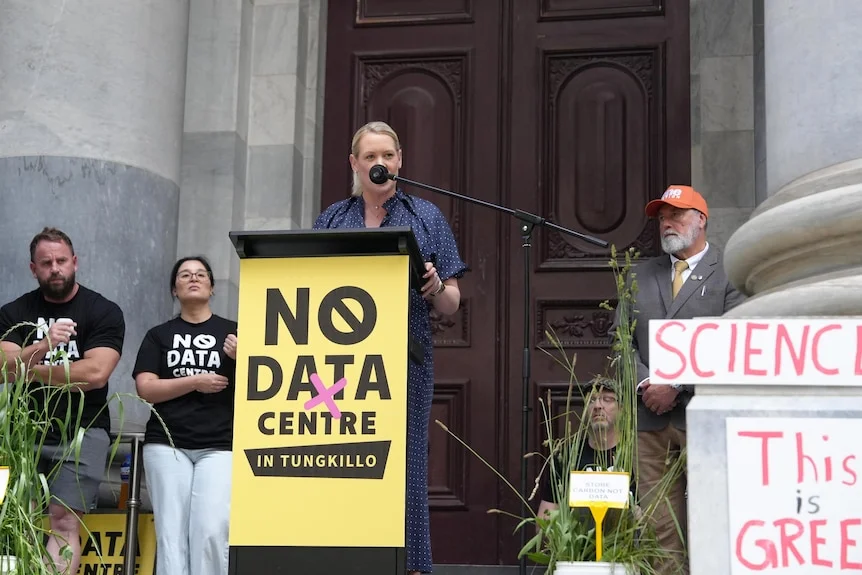
Ashton Hurn says Tungkillo is prime agricultural land that should be protected. (ABC News: Trent Murphy)
The developer's response
Quantum DC CEO Alby Tomassi said the company respected the right of community members to speak out. He said the message had landed. "We want people to know we have heard their concerns," Mr Tomassi said.
The concrete step is that the company has put its development application on hold. Mr Tomassi said it will now build a longer-term engagement program aimed at working through concerns "in a meaningful way."
That wording will get tested. The protesters have already said a pause isn't a stop, and the minister has made clear that engagement with the government should have come first. A longer consultation process buys Quantum DC time, but it doesn't address the core objection: that prime farmland and fire-prone hills aren't the right place for a facility of this scale.
My read is that the next few months will show whether this was a delay or a retreat. If the company returns with a changed site or a scaled-back design, the fight shifts to the details. If it returns with the same plan and a better communications strategy, the Adelaide Hills will be ready for round two.
Discussion
Sign in to join the discussion.