French prosecutors are investigating a firebomb attack on police as student demonstrations over education and living costs prepare to resume.
The firebomb attack on French police has become the clearest measure yet of how far Paris’s student protests have escalated. Prosecutors opened an investigation for the “attempted murder of persons vested with public authority” after an incendiary device struck a gendarme during Saturday’s demonstrations. That charge signals the seriousness with which investigators are treating the assault; it doesn’t establish who threw the device or what they intended. The distinction matters as authorities try to identify suspects while protests continue.
The officer suffered second-degree burns. Speaking to French television, he described skin that stung and a “rain” of projectiles aimed at his unit. Video and photographs from eastern Paris showed a device exploding near police, while prosecutors said explosive devices had been thrown at about 15 gendarmes and police officers. The accounts describe a crowd that could turn dangerous even as the wider demonstrations included peaceful participants. For officers on the ground, the immediate problem was less the politics of the protest than the volume and unpredictability of objects being thrown.
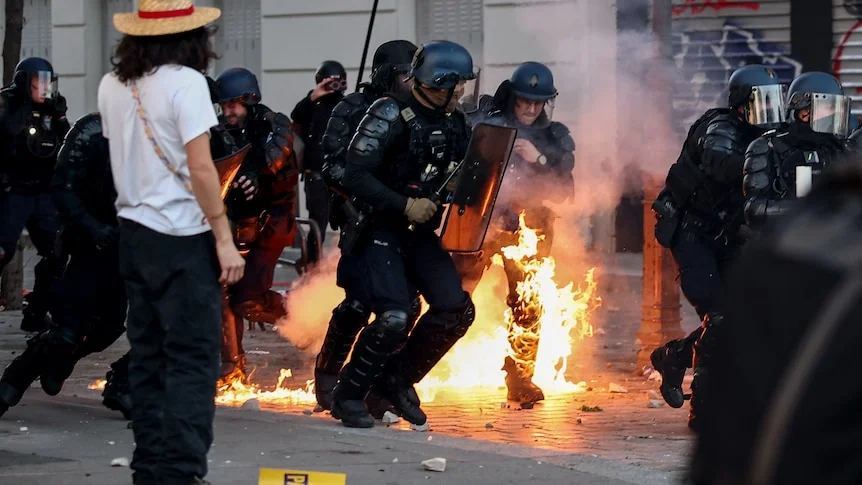
French riot police faced off with demonstrators as protests for the third weekend in Paris turned violent. (AFP: Sameer Al-Doumy)
Security response and arrests
Authorities deployed about 70,000 police and gendarmes nationwide to manage an estimated 320,000 protesters. The scale of that deployment reflects the challenge of responding to large gatherings spread across the country: police have to maintain public order while distinguishing between peaceful demonstrators and people accused of violence. The Paris Police Prefecture said several hundred people had attacked security forces with projectiles. More than 770 people were arrested across France, though prosecutors said no suspects had been taken into custody in the firebomb case as investigators worked to identify those responsible.
Those figures describe the breadth of the response, but they don’t by themselves explain how the clashes began or how many arrests relate to the attack on the gendarme. The gap between a large number of arrests and no custody in this particular case underlines the investigative work still ahead. Identification can take time, especially when authorities are dealing with incidents involving multiple people and a moving crowd. For now, the firebomb investigation remains a distinct thread within a much wider effort to manage the demonstrations.
A broad student movement, with a violent edge
The demonstrations, now in their third consecutive weekend, have drawn high school and university students protesting education conditions, inequality and living costs. These are connected but not identical concerns: students are challenging both the availability and quality of education and the pressures shaping everyday life. Most gatherings were peaceful, but Interior Minister Laurent Nunez said some rioters had inflicted “extraordinary” violence. That split is central to understanding the protests. The violence is serious, but it doesn’t describe every participant or settle the demands that brought people into the streets.
Here's the thing: a protest can be largely peaceful and still force the public debate to focus on its most dangerous moments. That can make it harder to hear what demonstrators are asking for, while the attacks themselves give authorities an urgent public-order problem to address. This is more significant than it looks. The government has to respond to violence without treating the underlying grievances as if they’ve disappeared.
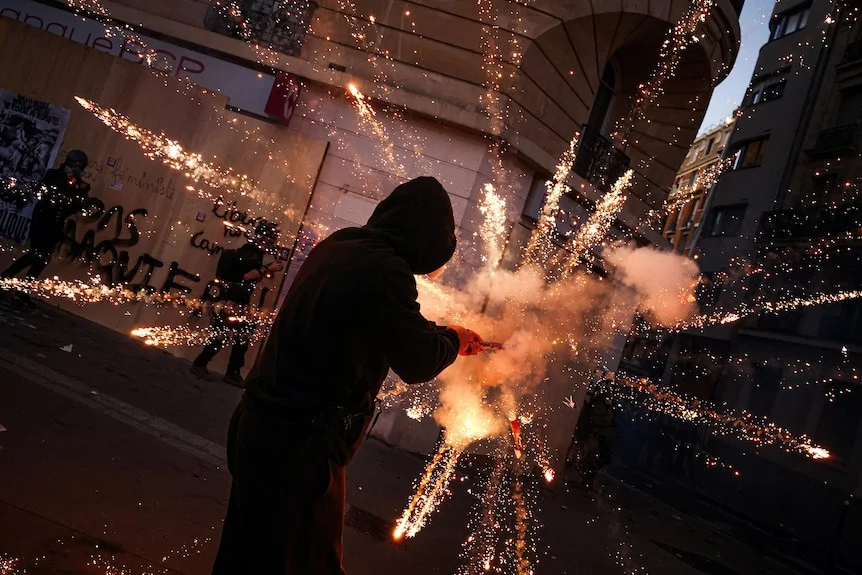
Rioters have been accused of targeting police with projectiles during the third weekend of France's protests. (Reuters: Pedro Nunes)
Retail damage eased as protests continued
The weekend brought fewer reports of business damage than earlier demonstrations. France’s Chambers of Commerce and Industry said around 20 businesses were affected, and the Interior Ministry reported no major incidents late Saturday. That’s a relative improvement, not evidence that disruption has ended: the trade group warned that repeated action could weigh on shops ahead of the year-end holiday period. For businesses, even a protest that causes limited direct damage can create uncertainty about access, staffing and customer visits. The concern is cumulative interruption, rather than a single night’s tally.
That said, the lower reported damage gives authorities and shopkeepers a different picture from the clashes involving police. A quieter evening can ease immediate pressure, but it can’t resolve the tension between students and the government. The competing signals make the next phase difficult to read: fewer reported incidents for businesses, alongside calls for school and university blockades to resume.
Student groups say blockades are set to resume as students return from a two-week break. Pierre Sourzat, head of the Lyceens! group, told broadcaster RMC that some schools could be blocked Monday, with wider action expected Tuesday. He said the group supported students taking part. The planned return to action would bring the dispute into schools and universities themselves, where access to classes may become a direct point of conflict. A proposed schedule is not a guarantee of how many institutions will be affected, but it gives the government and students an immediate test of their support.
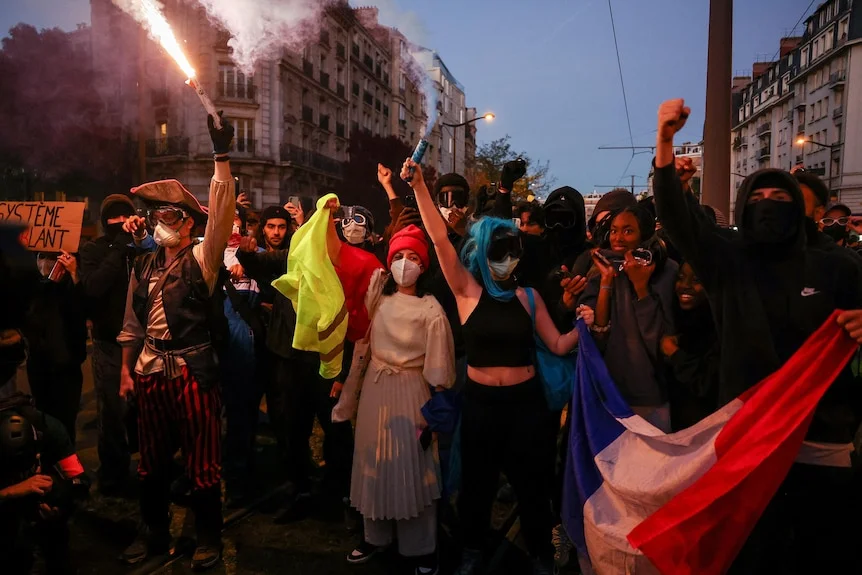
Demonstrations in Paris remained peaceful for hours before clashes broke out towards the end. (Reuters: Abdul Saboor)
Students say proposed changes fall short
The government has proposed replacing the university admissions platform and funding school renovations, but student representatives argue the measures leave core problems unresolved. Sabrine Kharbach, spokeswoman for the Union Etudiante, said university and high school blockades were planned for Tuesday and Thursday. The proposals address systems and facilities, while students’ objections also concern whether there are enough places in higher education and how classes are organized. That difference in emphasis helps explain why an announced response hasn’t persuaded student groups to suspend action.
Sourzat said a new admissions system wouldn’t address the shortage of higher education places. He also criticized a proposed class-size reduction that would apply only to 10th grade, saying students had sought changes across all year groups. His objections point to a familiar problem in education disputes: a change to the process of allocating places can leave the number of available places untouched. A limited classroom measure may also feel inadequate to students seeking wider changes. Those are Sourzat’s assessments, but they show how the government’s proposals are being judged by the people organizing the protests.
President Emmanuel Macron has urged a calm return to classes, saying young people had been heard. Sourzat rejected that assessment, telling RMC: “the president hasn't listened to us.” The disagreement is about more than tone. The government is asking demonstrations to give way to a return to school, while student representatives are arguing that the proposed changes don’t address the problems they’ve raised. If you're working in this space, the practical question is whether students see enough in the proposals to change course.
What the next phase will test
The next blockades will offer a visible measure of whether the student movement can sustain participation after the break. They’ll also test whether the government’s proposals can persuade students who say the changes are too narrow. A return to classes could reduce pressure in the streets, but it wouldn’t necessarily show that the dispute has been settled. And yet, a renewed wave of blockades would leave officials balancing education access, public order and demands for a clearer response.
The numbers here are underwhelming as a measure of political resolution: they tell readers how many people gathered, how many were arrested and how many businesses were affected, but not whether students feel heard. The attacks on police have sharpened the immediate security question. The education dispute remains open.
Discussion
Sign in to join the discussion.