NASA's recent identification of a massive Moon crater sheds light on infrequent lunar impact occurrences, enhancing our understanding of the Moon's geological history.
When NASA scientist Robert Wagner first identified a bright anomaly on the Moon's surface in 2025, he had unknowingly discovered the largest newly-formed crater known to exist within the solar system. This crater, officially named the McGetchin crater, measures 222 meters in diameter and 43 meters in depth, rivaling the Roman Colosseum in size. Such a significant find not only underscores the Moon's geological activity but also piques our interest about what else might be uncovered in lunar research.
The Impact Event Behind the Discovery
The formation of the McGetchin crater is linked to a major impact event that took place roughly a year prior to its discovery, marking an occurrence NASA estimates happens every 132 years. Given the period between detected impacts, scientists believe events like this one hold valuable insights that can inform both current lunar research and future explorations. The Moon serves as a record of such impact histories across billions of years, revealing much about our solar system's tumultuous past.
Indeed, the characteristics of the McGetchin crater could provide key information about the conditions and composition of lunar materials. The investigation into the materials disturbed during the impact can lead to broader determinations regarding the Moon's geological processes, the nature of the impacting body, and even clues about the history of impact events throughout the solar system.
How Was the McGetchin Crater Discovered?
The LRO's ability to identify surface changes relies on complex imaging techniques that capture before-and-after comparisons of lunar terrain. NASA utilizes a series of high-resolution images to uncover shifts, which have become pivotal in studying the Moon's topology. This sort of scrutiny hasn't always been possible; earlier lunar explorations provided limited data, meaning real-time monitoring represents a breakthrough in planetary science.
The crater's detection was facilitated through a meticulous analysis of LRO imagery, leading to the confirmation that it resulted from an asteroid or comet strike, possibly comparable in size to a three- to six-storey building. The event likely occurred between April 11 and May 22, 2024, before Wagner's observation. This precise narrowing of time offers potential leads for researchers focused on impact predictions and helps outline revisiting protocols for lunar observations.
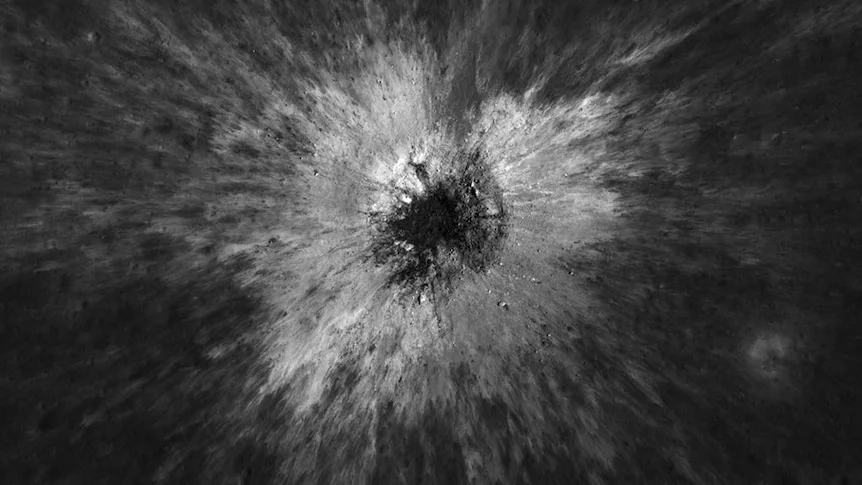
The newly-discovered McGetchin crater spans about a kilometer. (Supplied: NASA Goddard/Intuitive Machines/Robert Wagner)
Exploring the 'Cold Spot'
In conjunction with its imaging capabilities, the LRO employs thermal sensors to detect temperature variances across the lunar surface, which can indicate geological shifts. This multipronged approach revealed an intriguing 6.5-kilometer region around the McGetchin crater that exhibited cooler temperatures at night—uniquely identifiable as a "cold spot." Understanding these thermal dynamics is more than just an academic pursuit; it offers real insights into how impacts alter the environment.
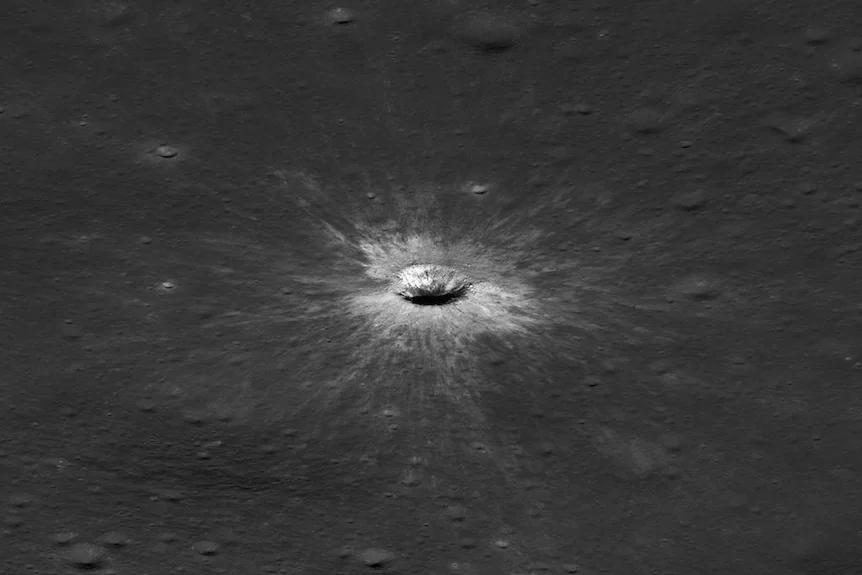
The Moon's newest crater measures about 43 metres deep. (Supplied: NASA Goddard/Intuitive Machines/Robert Wagner)
This cooler zone arises from the disturbance of the regolith caused by the impact, leading to a less dense and heat-retaining surface. As NASA notes, the breadth of this cold spot highlights the extent of surface modifications due to impacts, which may complicate future rover missions on the Moon. The impact could lead to areas where heat retention may affect scientific instruments or even future human habitat cold-spots.
The Frequency of Lunar Impacts
Impacts on the Moon occur with surprising regularity. Annually, around 140 new craters are documented, although many of these result from small meteoroids creating craters that are too small for the LRO to capture in detail. The spacecraft can identify craters as small as nine meters across, but craters of that size might not illustrate the grandeur or effects of larger impacts like McGetchin.
Wagner's identification of the McGetchin crater serves as a reminder of the dynamic processes shaping the Moon's surface. Each discovered crater enhances scientists' understanding of lunar geology while also expanding our knowledge of cosmic interactions. This is more significant than it looks: craters on the Moon can serve as historical markers, each one a testimony to the forces that have shaped not only the Moon but also the Earth and our solar system as a whole.
The comprehensive efforts taken by Wagner and his team spotlight the intricate relationship between monitoring technologies and the ongoing study of lunar impacts. If you're working in this space, the McGetchin crater may encourage a rethink of how we gather and interpret data on impact events. The more we understand these phenomena, the better equipped we are to handle emerging challenges, such as planetary defense.
Implications for Future Lunar Exploration
The ramifications of discovering the McGetchin crater extend beyond mere scientific curiosity. The crater's existence suggests a continuous cycle of impact and geological transformation that could shape future exploration strategies.
NASA’s ongoing interest in lunar missions makes this discovery particularly timely. Future crews or robotic missions exploring the Moon will need to consider the implications of such large impacts. The accessibility and stability of lunar terrain are weighed against natural hazards posed by unanticipated impact events.
Moreover, insights garnered through studies of the McGetchin crater can refine our understanding of the Moon’s regolith and its properties, potentially informing how we might use lunar materials for future habitats or resources. In this sense, improving impact monitoring and understanding the resulting geological features could reshape our ambitions for lunar colonization.
There's a lot to unpack here, and this is the part most people overlook. Scientists must tread carefully when theorizing about the Moon’s active geology without the concrete evidence gathered from extensive data analysis and field missions.
Discussion
Sign in to join the discussion.