Houthi rebels have captured the Greater and Lesser Hanish islands, tightening their grip on a vital shipping route and escalating regional tensions.
Leaders from Yemen’s Iranian-backed Houthi forces have announced their recent capture of additional strategic islands in the southern Red Sea, significantly augmenting their control over a critical maritime shipping route. This move underscores not just the Houthis' military ambitions but also illustrates the broader geopolitical frictions at play within the region.
The islands in question, Greater and Lesser Hanish, were secured amid attempts by Saudi-backed Yemeni government troops to regroup following the Houthis’ swift advances around the Bab el-Mandeb Strait—a crucial alternate route for shipping that rivals the Strait of Hormuz. The Bab el-Mandeb Strait serves as a pivotal corridor connecting the Red Sea to the Gulf of Aden, making these islands strategically important not just for the Houthis, but also for international shipping lanes.

Members of the Saudi-backed Yemeni government forces react during what they say to be clashes with Iran-aligned Houthis in Al-Hazm, Yemen. (Reuters: Media Centre of the Yemeni Armed Forces)
The Houthis swiftly deployed their fighters to occupy the islands, which sit approximately 160 kilometers north of Bab el-Mandeb, after a significant number of government-allied forces retreated from the area. This rapid maneuver illustrates the effectiveness of the Houthis' positioning and strategy amid ongoing conflict. Such gains cannot be understated, as control over the Hanish islands solidifies the Houthis' maritime capabilities.
Imposing Maritime Stronghold
This latest advancement enhances the Houthis' capacity to threaten vital Saudi crude oil shipments, which have increasingly relied on the Red Sea due to ongoing Iranian hostilities in the Strait of Hormuz. The potential for disruption is alarming, particularly in an already volatile oil market sensitive to geopolitical tensions. Oil supply lines are the lifeblood of economies, and any threat to them reverberates beyond the immediate region.
The rising tensions are underscored by the Houthis’ direct assaults on Saudi oil infrastructure. Each attack raises alarms over possible interruptions to global oil supply chains, which could lead to price hikes—an outcome that may fortify Iran’s negotiating stance vis-à-vis U.S. and Western allies. What this means for you: if you're watching the energy markets, prepare for volatility as these events unfold.
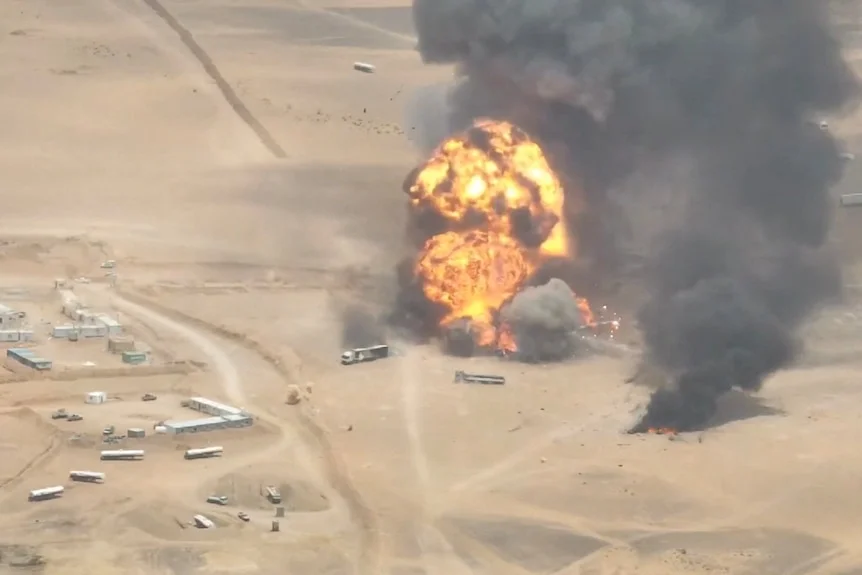
Trucks explode during what the Houthis say was an attack targeting vehicles coming from Saudi territory, at the Al-Wadiah border. (Houthi Media Centre via Reuters)
This recent seizure of the Greater and Lesser Hanish islands follows another successful operation where the Houthis took control of the port city of Mokha on Yemen’s mainland and the island of Mayun. Both locations sit strategically within the Bab el-Mandeb Strait’s sphere of influence. This is more significant than it looks; the ports enable not just military logistics but also potentially influence access for humanitarian aid, key in an area ravaged by war.
The implications of these gains mean the Houthis are now positioned merely 32 kilometers away from a key U.S. military installation located in Djibouti, just across the strait. The proximity raises the stakes for U.S. engagement and could impact military strategy in the region.
Attacks on Saudi Infrastructure
In a calculated response, the Houthis have recently targeted a Saudi military air base in Khamis Mushait with a barrage of missiles and drones, inflicting damage on significant military assets. This offensive is characterized as a retaliatory measure, primarily directed at the Saudi air strikes that have intensified against Yemen in recent weeks. Such moves by the Houthis reflect a tactical desire to push back against Saudi advances while also testing their military capabilities.
Despite minimal resistance from the Yemeni government's forces, attempts to regroup and advance toward Dhubab—north of the strategically vital strait—are underway. The ongoing conflict is edging Yemen toward a renewed period of civil war, extinguishing what was a fragile truce held for the past three years.
Cancellation of Diplomatic Talks
In light of rising hostilities, a diplomatic gathering set for Monday among Arab states and Iranian representatives in Oman has been abruptly called off. Initially, the meeting aimed to address negotiations regarding reopening the Strait of Hormuz. This suggests the increasingly hostile environment is hampering efforts to even discuss resolutions.
Oman’s Foreign Minister, Sayyid Badr Albusaidi, attributed the postponement to a need for consensus, marking yet another setback for regional diplomacy as tensions escalate. This situation not only highlights the fragile state of diplomacy in the region but also underscores the complexities inherent in Iran’s relationships with its neighbors. (and this is the part most people overlook) The Iranian influence in Yemen has ramifications far beyond its borders, affecting trade and security policy in multiple countries.
Implications for the Future
The situation in Yemen is poised on a knife’s edge. The Houthis’ military gains not only threaten regional stability but also complicate international shipping routes critical to the global economy. If you're working in this space, these developments will have a significant impact on trade and security policies in the surrounding nations.
The potential for increased military engagements raises questions about the future role of the U.S. and its allies in the region. The delay in diplomatic talks suggests a growing entrenchment of positions rather than movement toward a resolution. As conflict escalates, outside powers might find themselves reevaluating their strategies to navigate the shifting power dynamics.
In conclusion, Yemen's situation is representative of deeper geopolitical tensions that cannot be ignored. As the Houthis continue to expand their territorial gains and Saudi-led forces attempt to regroup, the potential for wider conflict looms large, putting not just Yemen but the broader Middle East at risk of instability.
Discussion
Sign in to join the discussion.