The Khabarovsk submarine enhances Russia's nuclear capabilities, but rising conventional threats challenge the efficacy of nuclear deterrence strategies.
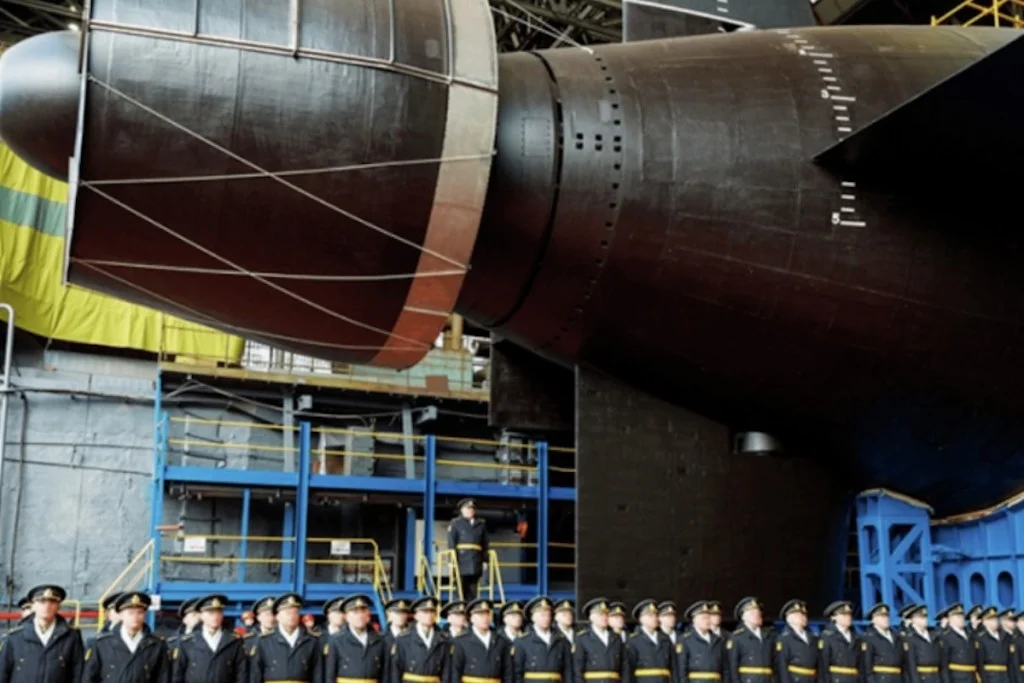
Russia's Khabarovsk submarine is more than just a vessel; it signifies a strategic pivot towards advanced undersea warfare capabilities amid shifting global dynamics. Its recent sea trials, the first since construction began in 2014, mark a pivotal moment in Russia's military modernization efforts, showcasing its commitment to deploying the Poseidon strategic nuclear drone system.
Departing from Severodvinsk, this submarine is the country’s first specifically designed to launch Poseidon drones, elevating Russia's nuclear posture with a focus on second-strike capability. Equipped with six 2P39 launchers, the Khabarovsk can deploy the 2M39 Poseidon underwater drones, each a megaton-class nuclear weapon engineered to target critical military infrastructure, including coastal facilities and carrier strike groups, post-initial strike.
The Poseidon drone is noteworthy for its operational depth of around one kilometer and remarkable speed, reaching up to 200 kilometers per hour. With a range of approximately 10,000 kilometers, these drones are engineered to navigate complex underwater routes, capable of bypassing traditional anti-torpedo defenses. This design underscores a strategic shift towards stealth and distance in nuclear deterrence.
This development not only reflects Russia’s ambition to enhance its undersea capabilities but also signals a broader shift in the strategic balance, particularly in light of weak arms control treaties. With the New START treaty set to expire in February 2026, the Khabarovsk's operationalization may occur in a context where existing arms control frameworks are ineffective, raising concerns about a new arms race.
Other members of Russia's so-called "superweapons" cohort include the Sarmat super-heavy ICBM and the hypersonic Avangard and Zircon missiles, all aimed at countering growing US missile defense capabilities. While the Khabarovsk supports this arsenal, incidents in the ongoing Russia-Ukraine war raise critical questions about the survivability and effectiveness of Russia’s nuclear deterrent capabilities.
Recent attacks on Russian submarines illustrate vulnerabilities that challenge the long-held belief in the invincibility of sea-based deterrence. For instance, in late 2025, Ukraine succeeded in destroying Russian assets using unmanned underwater vehicles, suggesting a potential shift in maritime warfare dynamics that threatens traditional nuclear strategies.
The precarious situation faced by Russian SSBNs, particularly in light of Ukraine's offensive capabilities, forces a reevaluation of their operational security. Reports indicate that the Russian Navy has begun implementing countermeasures, such as anti-drone netting on submarines in the Black Sea, highlighting an urgent need for adaptive strategies in response to evolving threats.
Moreover, concentrating multiple Poseidon drones within a limited number of Khabarovsk-class submarines creates a precarious scenario. The potential loss of just one submarine could substantially degrade Russia's nuclear deterrent in the Pacific, necessitating a reliance on more traditional methods that might prove vulnerable to US missile defenses.
What becomes intriguing is the shift in how nuclear-armed states conceptualize deterrence amid increasing unconventional threats. Ukraine's bold operations demonstrate that striking at high-value strategic assets no longer invites assured nuclear retaliation, a paradigm previously considered sacrosanct. Instead, Russia's response to significant UAV and missile strikes has often been conventional, framing a new era in deterrence where traditional nuclear threats may be perceived as blunt and less credible.
As new technologies evolve, the role of nuclear weapons may come under further scrutiny. With capabilities such as AI-driven cyberattacks and precision-guided munitions testing the thresholds of conflict, adversaries can inflict substantial strategic damage without triggering nuclear escalation. The emergence of such technologies may alter the calculus of war, assuming a more prominent role where conventional forces are prioritized over the specter of nuclear retaliation.
In essence, while the Khabarovsk submarine is an embodiment of sophisticated military advancement, it remains a focal point within an outdated paradigm of deterrence. As adversaries leverage strategies that operate below the nuclear threshold, the efficacy of traditional nuclear deterrents like the Khabarovsk and Poseidon may be increasingly questioned. The future of nuclear deterrence could lie less in the capability for catastrophic retaliation and more in the ability to manage and adapt to ongoing conventional and hybrid threats.
Discussion
Sign in to join the discussion.